



A 100 kW solar system needs more than 100 kWh of battery whenever the valuable discharge window lasts longer than about one hour or the project must carry reserve, backup, or multi-day energy shifting. A solar system is often described by its PV capacity, yet the electricity that matters at a site changes with time. A 100 kW array may produce a strong midday output while the building’s largest demand arrives in the evening. In that situation, adding more panels does not automatically provide more useful energy. The battery’s power and energy roles must be separated.
The question becomes practical when a factory, warehouse, or commercial building has a high evening load, a constrained grid connection, or a demand charge based on a short interval. A battery can shift solar, reduce export, support a critical load, or perform several duties. Each duty changes the required energy, inverter power, reserve, and recharge window.
Compare the PV Curve With the Load Curve
Start with interval electricity data and an hourly or sub-hourly solar model. Mark the hours when PV exceeds site demand, the hours when the site imports power, and the hours when the meter sets a demand charge. The gap between these curves shows whether the battery needs to absorb surplus, discharge after sunset, or respond to a short peak.
Power and Energy Answer Different Questions
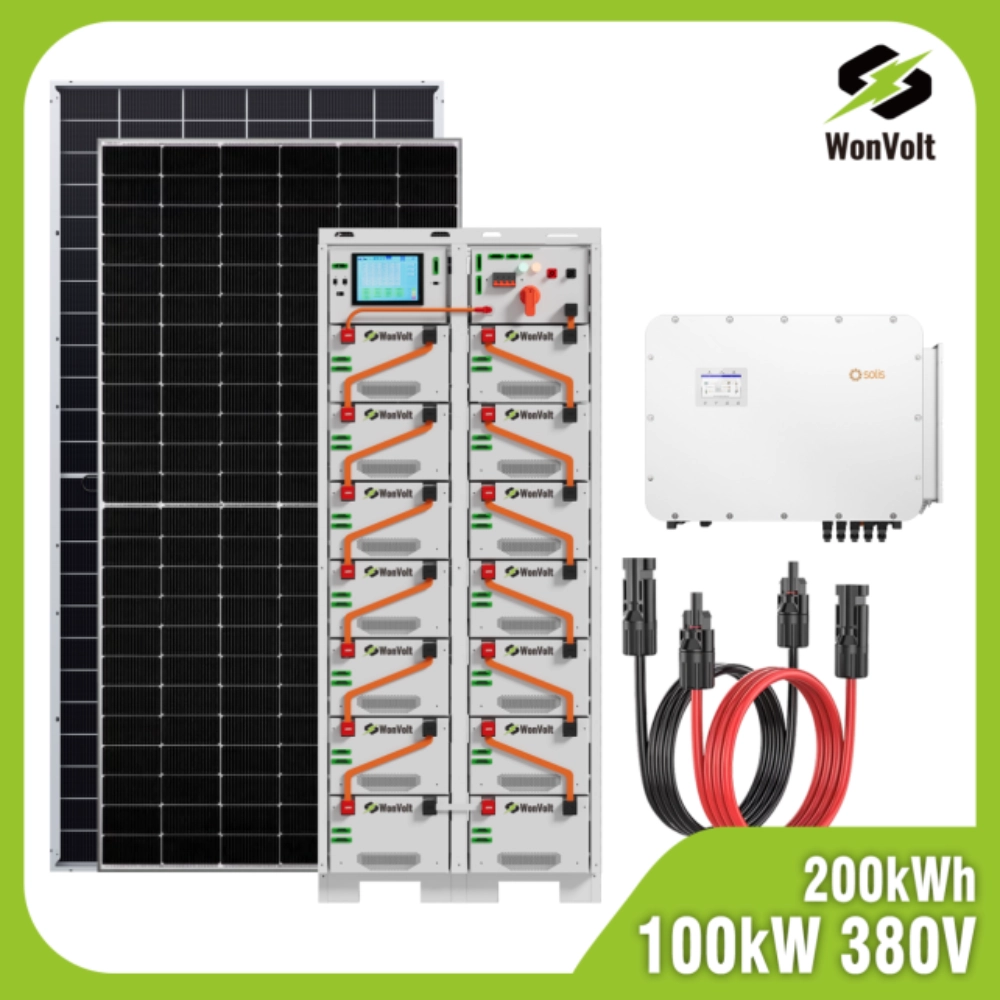
Battery power, measured in kilowatts, determines how quickly the system can change the site’s import or support a load. Battery energy, measured in kilowatt-hours, determines how long that power can continue. A high evening load may need moderate power for several hours. A short motor peak may need high power but little energy. The WonVolt configuration combines 100 kW of PV, a 100 kW inverter, and 200 kWh of lithium storage.
PV power has its own limits. Inverter conversion, cable capacity, temperature, clipping, export restrictions, and irradiance determine how much of the array’s nameplate reaches the AC bus. A battery that is too small may fill early and leave later solar curtailed. A battery that is too large may remain underused if the site has no evening demand or backup duty.
Find the Hours When Battery Energy Creates Value
A battery is more useful than additional PV when the site regularly has a mismatch between production and consumption. Examples include evening refrigeration, shift-based manufacturing, hotel loads after sunset, or a facility that cannot export all midday generation. The analysis should show how much energy can be shifted on ordinary, cloudy, and high-production days.
Do Not Count the Same Energy Twice
Energy used for self-consumption cannot also be counted as exported energy avoided or demand reduction in the same interval. Dispatch models should define the priority order: protect backup reserve, serve local load, reduce the demand peak, charge from PV, and export any permitted remainder. The order should be tested against tariffs and operating risk.
Battery round-trip efficiency and auxiliary consumption reduce the energy returned to the load. The model should use AC-side energy at the same meter boundary used for savings. A battery charged with 100 kWh of PV does not deliver 100 kWh later after conversion losses, standby consumption, temperature limits, and reserve are included.
Set the Battery Around the Evening Duty
The 100kW 200kWh Hybrid Solar Power System can be evaluated when a site needs a defined relationship between a 100 kW hybrid power level and a larger stored-energy window. Confirm the current product configuration, PV input, battery chemistry and usable energy, operating modes, grid connection, protection, cooling, communications, and the load profile that determines the expected discharge period.
WonVolt’s industrial and commercial solution supports project discussions around solar, storage, and dispatch. The system should not be selected from the 100 kW label alone. Check the maximum battery charge and discharge power, the duration at the intended power, state-of-charge reserve, generator interaction, and the time available to recharge before the next demand event.
Account for Clipping, Export, and Reserve
If the PV inverter reaches its AC limit at noon, extra solar can be clipped unless a battery has charge headroom. That does not mean every clipped kilowatt-hour can be recovered. Battery charge power, state of charge, temperature, control response, and the site’s simultaneous load determine how much surplus is captured. A financial model should show curtailed energy before and after storage. Give every stored kilowatt-hour one purpose in the model.
Backup reserve changes the usable portion of the battery. If the facility must retain energy for a grid outage, economic dispatch cannot use the whole nameplate every day. The reserve may also rise before severe weather or maintenance. The annual model should treat reserve as an operating rule, not a hidden reduction applied after the savings estimate.
Test the Hybrid System at the Meter Boundary
Commissioning should observe PV production, battery DC or internal values, AC import and export, load demand, state of charge, and control commands on a common timeline. Test a high-solar charging event, an evening discharge, a demand peak, a grid disturbance, and recovery. Check that the system does not charge from the grid when the operating rule permits PV-only charging. Published system information states a grid-failure transfer of no more than 10 ms and support for paralleling up to three units.
WonVolt’s solar product range and project contact can support a design review using roof layout, weather data, tariff, load profile, grid limit, and desired backup. Acceptance should define useful energy at the AC meter, response time, reserve level, and the conditions that allow the system to change modes.
Compare Alternative Sizes With the Same Dispatch Rules
Run several battery energy sizes while keeping PV, load, reserve, tariff, charge power, and control priorities constant. Report curtailed PV, self-consumption, peak reduction, backup coverage, annual cycles, and unused capacity. The best size is not the one with the most stored energy; it is the one whose additional energy still performs a valuable duty.
Sensitivity testing should include electricity-price changes, load growth, weaker solar years, and a reduced usable battery window. This shows whether the project remains useful when assumptions move. One perfect-year forecast can hide a design that depends on every condition remaining favorable.
Use Several Consecutive Days in the Model
A single sunny-day simulation can make the battery look fully available every morning. Model cloudy sequences, weekend loads, shutdown days, and a high evening demand after weak solar production. Check whether the battery reaches the reserve, whether grid charging is permitted, and how much PV is curtailed when the battery remains partly full.
The result should report useful AC energy, not only DC nameplate capacity. Show charge and discharge loss, auxiliary power, reserve, maximum power, duration, and the state of charge before each important event. This reveals whether additional battery energy will actually be cycled or simply remain unused.
FAQ
Q1: When does a hybrid solar system need more battery energy than PV power?
A: It may need more stored energy when a large evening or backup duty continues after solar production ends, even if the PV array is 100 kW.
Q2: Is a 100 kW PV array enough for a 100 kW battery inverter?
A: Not automatically. PV output, battery charge and discharge limits, AC connection, load profile, and operating modes must be matched.
Q3: Can a battery recover all clipped solar energy?
A: No. Charge power, available energy capacity, state of charge, site load, conversion loss, and export rules limit recovery.
Q4: Why must backup reserve be included in the financial model?
A: Energy held for outages is not available for daily economic dispatch, so using the full nameplate would overstate annual savings.
Q5: What data is needed to size a hybrid solar system?
A: Use interval load, PV layout and production, import and export limits, tariff intervals, backup loads, outage targets, battery limits, and the desired dispatch priority.