



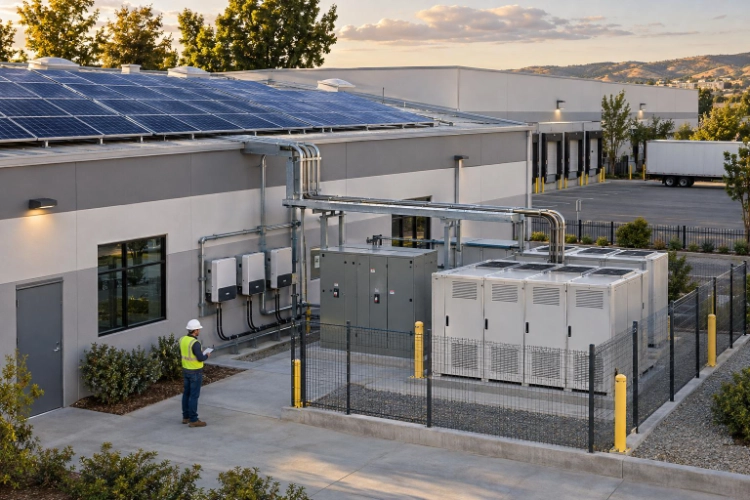
There is no honest one-word answer to “AC coupling or DC coupling?” Adding storage beside an older warehouse PV system is one sort of job. Drawing a new solar-plus-storage plant from scratch is another. The kWh figure might match, while the wiring, inverter work and control scope do not.
Begin with the one-line drawing. Find the point where battery and solar meet, note the equipment between them, then mark the meter facing the load or grid.
That power path cuts through quite a bit of sales talk.
Read the AC-coupled power path
AC coupling normally gives PV and storage their own conversion equipment. The PV inverter places solar power on the AC bus. To charge, the battery PCS converts that AC back to DC; during discharge it turns battery DC into AC again.
That separate connection makes sense for many retrofits. The old PV inverter keeps doing its job, while a bidirectional PCS creates a new route for the battery.
“Separate” does not mean “plug in anywhere.” Switchgear rating, transformer capacity, protection settings, export control and meter positions still need checking. A neat battery skid does not solve a crowded main switchboard.
What changes with DC coupling
With DC coupling, PV and battery meet before the main DC-to-AC conversion. Depending on the design, there may be DC-DC equipment and a shared inverter stage. The label alone does not show enough. Ask for the single-line diagram.
The U.S. Department of Energy lists both arrangements in Solar-Plus-Storage 101. On the DC route, solar can reach the battery before the AC conversion step.
That can suit a new project where the PV array, battery voltage window and inverter are chosen together. It also joins those equipment choices more tightly. Change the battery block later and the PV-side assumptions may need another look.
Trace the energy instead of comparing slogans
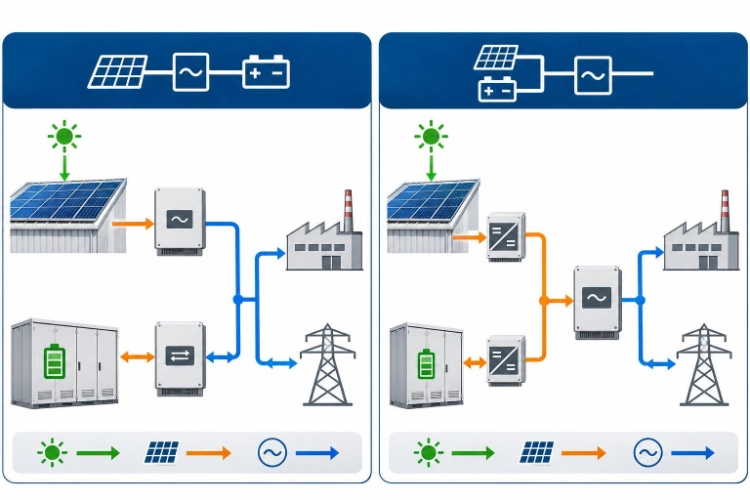
An efficiency figure is meaningless until the route is named. Solar charging, grid charging and battery discharge don’t travel through the same equipment.
Solar to battery
For AC coupling, solar power usually goes through the PV inverter, reaches the AC bus and then goes through the battery PCS. DC coupling can send solar energy to the battery on the DC side before the shared inverter.
This is the source of the clipping argument. A DC design may catch solar production above the inverter’s AC limit. The value changes with array size, weather, dispatch timing and the spare room in the battery at midday. Borrowing a percentage from another plant proves little.
Grid to battery
An AC-coupled battery has a normal bidirectional path from the AC system, subject to the PCS design, controls and interconnection permission. Grid charging is therefore easy to show on the drawing.
Grid charging is also possible in some DC designs, but the route varies. Ask the supplier to put it on the one-line and explain the operating permission. This becomes important wherever tariffs or incentives distinguish grid energy from solar energy.
Battery back to AC
The factory and grid still need AC power at the end of either route. PCS rating caps discharge power. So 1 MWh behind 250 kW will not cover the same peak as 1 MWh behind 500 kW, even though both offers show the same energy capacity.
The DOE solar power electronics overview separates the jobs neatly. PV inverters make AC from solar DC; a bidirectional converter can work in both directions for battery charge and discharge.
Existing PV usually pushes the discussion toward AC coupling
Picture a working factory system. The rooftop array, PV inverters and grid agreement are already in place. The owner now wants to trim a short demand peak and keep several loads running during an outage.
An AC-coupled battery can give that new scope a visible boundary. The old PV DC design stays largely on one side; the battery PCS and its controls sit on the other. Warranty and service discussions are often easier when the two packages are not sharing the same DC equipment.
There is still real engineering to do. The main board may have no spare capacity. The transformer could become the limiting item. And backup operation needs a transfer arrangement, load separation, protection and the right PCS capability. A grid-connected battery does not become a backup system just because the word “hybrid” appears in an offer.
Reasons to study an AC-coupled option
- The solar plant is already operating.
- The owner wants a clean work boundary around the existing PV equipment.
- Charging from the grid is part of the schedule.
- PV and battery service access should stay fairly independent.
- Battery capacity may grow without changing the PV array.
Use that list to start the study, not to sign it off.
New-build projects give DC coupling more room
A bare site gives the EPC more freedom. PV strings, DC-DC equipment, battery blocks and inverter capacity can be sized together. Potentially clipped production can go into the model before purchase orders lock the hardware.
Shared conversion can remove some duplicate equipment. The trade is tighter dependence: battery, array and inverter must live inside the same voltage and operating boundaries. Later expansion therefore reopens more of the design.
Reasons to study a DC-coupled option
- PV and storage are being bought in the same project.
- The array will be oversized against the AC inverter and clipping is worth examining.
- The operating plan works with shared conversion equipment.
- One EPC can manage the combined PV, battery and inverter design.
- The owner understands that later changes may reopen the DC-side study.
“DC coupled” says nothing about whether the controls are any good. On a bad operating day, meter placement, signal quality, alarm rules and command priority decide the outcome.
Put the project conditions side by side
| Project point | AC-coupled battery storage | DC-coupled battery storage |
| Adding storage to old PV | Usually easier to separate from the existing DC system | Can require more PV-side redesign |
| Conversion equipment | PV inverter and battery PCS are separate | PV and battery share or coordinate more of the conversion path |
| Clipped solar | Usually remains behind the PV inverter limit | May be captured on the DC side if the system is designed for it |
| Grid charging | Straightforward to show through the bidirectional PCS | Depends on the chosen topology and controls |
| Maintenance boundary | PV and battery packages can be more independent | DC equipment and operating windows are more connected |
| Expansion | Battery changes may leave the PV array alone | Battery, DC voltage and inverter assumptions may all need review |
Use the table for a first pass only. The load curve, energy model and interconnection study still have the last word.
Controls are where tidy drawings meet a messy factory day
A factory can hit four limits at once: PV output, grid export, reserved SOC and transformer capacity. Then a compressor starts and moves the load again.
Write down who wins when those limits clash. Solar may serve the load, then charge storage, while the battery waits for the demand peak. But perhaps part of that battery is reserved for an outage. And if the export meter goes silent? The control narrative needs an answer.
Ask who issues each command and which device can refuse it. Cover communication loss, low SOC, battery alarm, grid outage and manual operation. A protocol name by itself is not a control plan.
Give the supplier enough to answer the RFQ
“Quote a 500 kWh battery” leaves too much blank space. Send:
- Existing or planned PV capacity and inverter models.
- Point of interconnection and transformer data.
- Site load curve, including the peaks the battery should cover.
- Required battery power, usable energy and backup reserve.
- Whether grid charging is permitted.
- Export limit and meter position.
- Loads that must stay on during an outage.
- Expansion plans for PV, battery and PCS.
- Required control interfaces and owner system.
- A request for the proposed single-line diagram and control narrative.
The WonVolt product library brings the battery, inverter and solar equipment groups into one place. Use it for a shortlist; use the project drawing and operating target for the actual architecture.
Send the solar layout, load data and required operating modes through the WonVolt website. Ask the reply to mark the connection point, power route and control boundary. A bare kWh number is not a design.
Conclusion
An existing commercial PV plant often gives AC coupling the easier starting point, since storage gets a separate AC route. On a new build, DC coupling has room to tie the array, battery and inverter together from day one.
One efficiency number cannot settle the choice. Draw all three routes – solar charge, grid charge and discharge – and then check meters, controls, export limits and future expansion.
FAQ
Is AC-coupled storage always the right retrofit choice?
No. Separating the new battery from the old PV DC side may help, yet the switchboard, transformer, protection and export control can still block a simple retrofit. Check the site one-line.
Is DC-coupled storage always more efficient?
No. It can remove conversion steps on the solar-to-battery route, while grid charging and discharge take other routes. Compare the offered equipment curves inside the site’s real dispatch model.
Can an AC-coupled battery run backup loads?
Yes, if the system is designed for islanded operation with suitable PCS behavior, transfer equipment, protection and separated loads. A normal grid-connected PCS does not prove that capability. Put the outage sequence into the technical specification.