



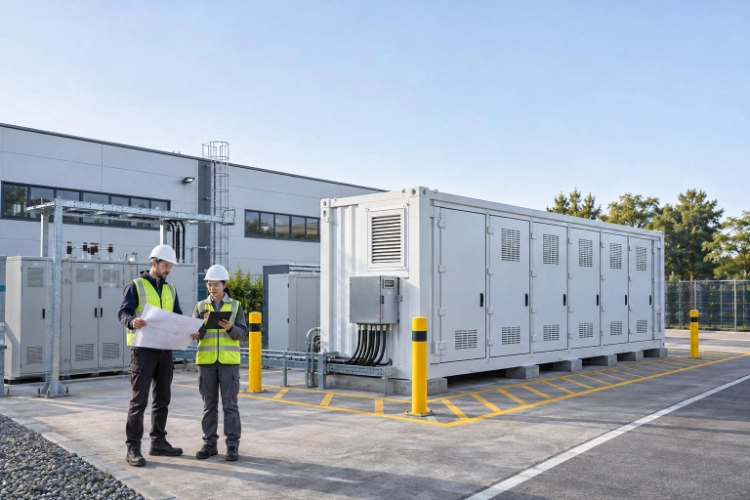
A file named “UL 9540A report” turns up with the offer. Fine, but don’t tick the box yet. Open it. Check the specimen first. The report should say whether testing stopped at cell, module or rack level, or went on to the container configuration in the offer.
Tender sheets often give these three names one small row. By the time submittals begin, that row can mean three different promises to three different people: a system record, fire-test evidence, or an installation requirement.
Split the papers before reviewing them. Keep system records together, fire-test work together and site-installation requirements together. A document for another build stays a mismatch, however impressive its cover looks.
Three names, three jobs
When the question is “what complete ESS has been evaluated?”, look at UL 9540. Its scope is energy storage systems and equipment, where the battery has to work with conversion, control and protection equipment.
UL 9540A is a test method. It looks at thermal runaway fire propagation and related fire or explosion behavior under a stated test setup. That last part is important. A test result belongs to the arrangement that was tested.
When the question becomes “how may this stationary ESS be installed here?”, NFPA 855 is the relevant name. Site conditions now matter: location, technology, system size, separation and fire protection. NFPA publishes the standard’s current identity on its NFPA 855 page.
UL 9540 therefore belongs beside the system record. UL 9540A belongs beside the thermal-runaway test evidence. NFPA 855 belongs beside the installation review. That sorting step is basic, but it stops one file from being used to answer three unrelated questions.
“Tested to UL 9540A” still needs a second question
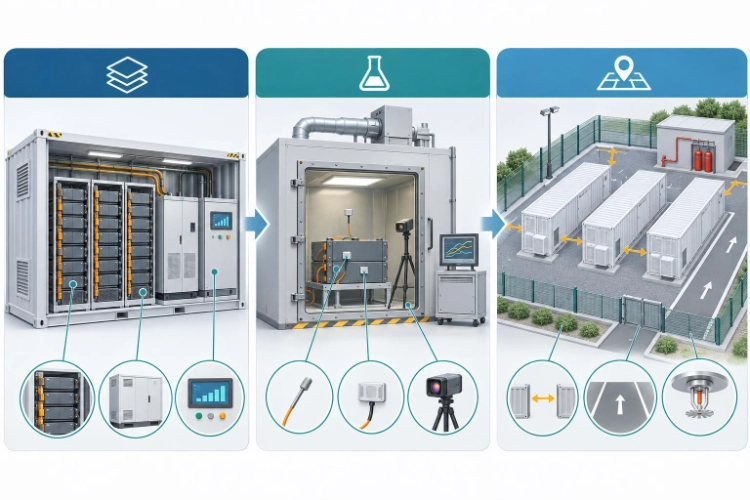
The reply can be brief: identify the tested configuration and state the test level.
Put the offered and tested versions of the cell, module, rack, enclosure, ventilation and protective equipment in adjacent columns. Add the report date and level. Anything left blank remains open for clarification.
Imagine that testing used one enclosure, but the offered unit adds racks and reroutes exhaust. Earlier test work may remain useful. The supplier still owes the project a written bridge between that evidence and the changed unit.
UL’s own ESS installation FAQ explains that installation codes can require large-scale fire testing on a representative ESS under UL 9540A. “Representative” is doing real work in that sentence. The test specimen and the supplied system need a traceable connection.
What to pull from the report
Do not stop at the cover page. Write down:
- cell and module identification;
- quantity and arrangement inside the rack;
- enclosure or container used for the test;
- detection, alarm, suppression, ventilation and exhaust conditions;
- spacing around the test unit;
- test level, report number, date and revision;
- any limits written into the findings or installation notes.
Interpretation can go to the fire engineer. Model numbers, drawings and revision dates can be checked at the commercial desk first. Doing that early saves specialist time on the wrong report.
A test report is not the system listing
The RFQ should request the UL 9540 system record and UL 9540A test evidence on separate lines. If both are required, receiving one line’s document does not close the other.
The same logic applies lower down the equipment list. A certified module also cannot speak for every possible battery, PCS and enclosure combination. Connecting approved parts creates interfaces, and those interfaces still have limits.
Check the AHJ position while the layout can still move
The authority having jurisdiction, or AHJ, controls the local review. Code adoption changes by place and date. Site conditions change the questions too: warehouse wall, rooftop and remote substation are not interchangeable locations.
Get early feedback while the site plan can still move. Extra separation may alter cable runs and road access, or cost the project one container position. On paper it looks like a dimension change; on site it is more than that.
What the local review needs to settle
Confirm adopted fire and electrical codes, site classification and the proposed BESS position. Record the reviewer’s expectations for access and separation. Do the same for detection, suppression, ventilation and explosion-control evidence, including when the complete UL 9540A material must be submitted.
Ownership is easy to overlook. Name the party writing the emergency response plan and the party producing commissioning and handover files. The EPC or fire consultant may own part of this work; the responsibility still needs a name beside it.
Make the documents follow the commercial offer
Open the quotation and build a one-page equipment list: battery model, rack quantity, container, PCS, controls and auxiliaries. Compare that exact list with the certification scope and test material.
Next, read the spacing and protection notes on the site drawing. Differences go into the shared clarification sheet. An email thread is too easy to lose.
This matters for an integrated container. The WonVolt utility-scale BESS page describes a package with battery, inverter, temperature control, safety protection and monitoring. A buyer therefore needs to look past the cell or rack and confirm the exact arrangement supplied for the order.
Better RFQ wording than “UL compliant”
Use a document schedule with entries such as these:
- The applicable UL 9540 record, naming the quoted system.
- UL 9540A report reference and the exact tested configuration.
- A written note covering every difference between the test build and the offered build.
- The current one-line and a matching equipment list.
- A description of detection, alarm, suppression, ventilation and exhaust.
- The installation manual and its environmental and spacing limits.
- Emergency shutdown and response information.
- Supplier and EPC commissioning deliverables.
This is not fancy contract wording. It just forces the files to answer the same technical question.
Warning signs worth stopping on
Pause when the certificate names another model. Pause again when a component report is described as a container test. Older rack revisions and auxiliary equipment that only appear on the sales drawing also need a written answer.
Do not jump straight from “different” to “rejected.” Ask for the engineering explanation first. Some changes can be covered properly. Others need more work. What matters is that the answer is written, specific and tied to the order.
Be careful with another sentence: “The AHJ will accept it.” A manufacturer can provide documents and technical answers. It cannot make the final decision for the local authority. The purchase contract should reflect that split.
Send enough site detail with the inquiry
“Please quote 2 MWh BESS” gives the supplier almost nothing to work with. Add the country, address, placement, kW and kWh target, available space, nearby buildings, likely code edition and anything the AHJ has already requested.
For a containerized BESS inquiry, contact WonVolt with that list and the required document schedule. Keep the technical clarification sheet open until every material difference has an answer. Dispatch week is far too late for this work.
Conclusion
The three checks meet at the same project. UL 9540 concerns the system, UL 9540A concerns test evidence, and NFPA 855 concerns installation. Keep their records separate even when they arrive in one submission.
The buyer’s work is mostly comparison, not theory. Read the model field. Compare the test build. Lay the installation limits over the site plan. That simple trail is what the engineers need when the review starts.
FAQ
Does UL 9540A certify the whole BESS?
No. It is a method for examining thermal runaway fire propagation and related hazards. Request the applicable system record on its own line, then verify that the tested setup corresponds with the offered equipment.
Can the UL 9540A report secure local approval on its own?
No. Local review covers the whole submission, not one report. Adopted code, location and layout remain part of the AHJ decision.
What files should arrive before a BESS order is released?
The usual pack includes applicable system certification information, the UL 9540A report reference and configuration, equipment schedule, fire protection description, installation limits, emergency information and commissioning deliverables. Project and AHJ requirements can add more.