



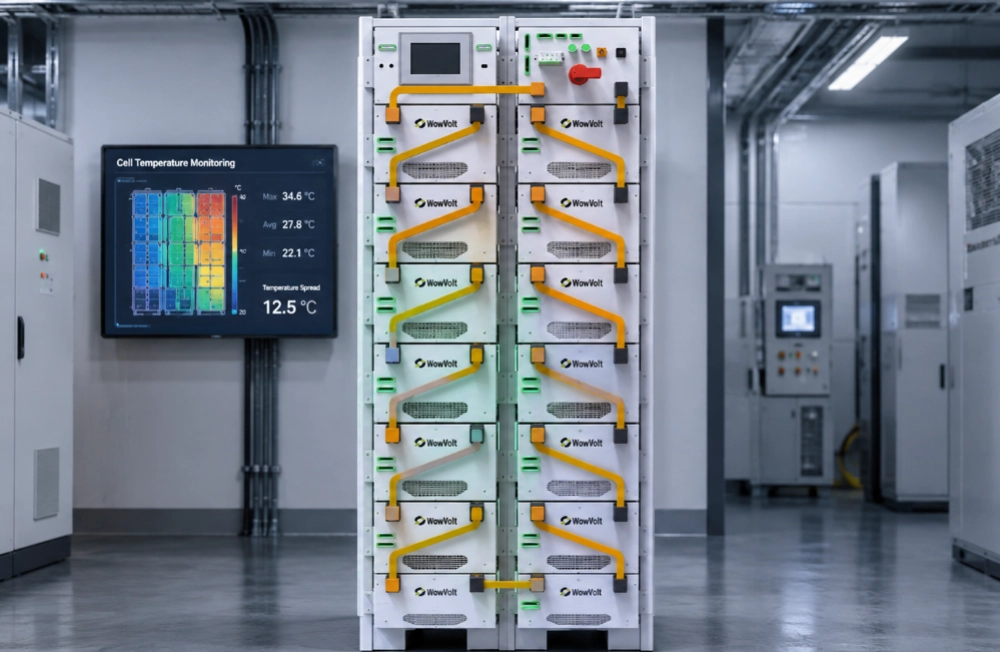
Cell-temperature spread reveals nonuniform resistance and cooling that an average temperature can hide, and persistent hot cells usually age faster and constrain usable cluster power. A commercial battery cluster is a group of electrochemical cells asked to behave as one source of power. Its safety and usable output depend not only on the average temperature, but on the difference between the warmest and coolest cells. A small spread may indicate normal position or airflow effects. A growing spread can reveal resistance, cooling, connection, or aging problems.
The issue matters in hot industrial rooms, containerized storage, and systems that charge or discharge repeatedly. Temperature affects cell voltage, resistance, permitted current, and the speed of aging. A battery management system can limit operation when conditions move outside its rules, but the quality of the result depends on sensors, placement, communication, and the thermal design around the cluster.
Why Average Temperature Hides a Problem
Suppose one module sits near a warm power-conversion component while another receives cooler air. The average may remain acceptable even though the warmer module reaches its current or voltage limit first. In a series-connected string, the weakest thermal position can determine the available operating window for the whole group. Trend the maximum, minimum, median, and sensor position together.
Resistance Turns Current Into Heat
Every cell and connection has resistance. During high current, that resistance produces heat. A slightly higher-resistance connection can become warmer, which may increase resistance further and create a local feedback loop. The same effect can appear in busbars, fuses, contactors, and cable lugs. Thermal inspection should therefore include the electrical path, not only the cell surfaces.
The relationship between current and heat is not linear in the way a casual check suggests. Heat generated by resistance rises approximately with the square of current. A cluster that looks calm during a low-power test may show a much wider spread during a fast discharge or a high-power recharge.
Read Temperature With the Battery’s Operating State
Temperature data becomes meaningful when it is time-stamped with current, voltage, state of charge, power command, ambient temperature, and cooling status. Compare the spread at rest, during charge, during discharge, and after the load is removed. A sensor that rises slowly after a power event may be showing stored heat rather than an active fault.
Check Sensor Placement and Response
Sensors do not measure every cell. They sample selected positions and can be affected by contact, insulation, air movement, and response time. The monitoring design should identify which cells or modules each sensor represents and what threshold triggers an alarm, derating, or shutdown. A clean data trend is not proof that an unmeasured position is equally cool.
Commissioning should compare sensor readings with an independent thermal observation where practical. Differences do not automatically mean the BMS is wrong, because surface and internal temperatures are not identical. The purpose is to establish a baseline and identify sensor behavior before the system carries commercial load.
Cooling Layout Changes Current Sharing
Air-cooled systems need an even path through the modules, clean filters, clear intake and exhaust routes, and control settings that match the cluster. Liquid-cooled systems add pumps, heat exchangers, hoses, valves, and leak detection to the maintenance plan. Either method can perform well if the design and inspection regime fit the environment.
Poor airflow does not always create one obvious hot spot. A blocked route can raise the temperature of a group, while a loose panel or bypass path can cool one area and starve another. Record inlet and outlet temperatures, fan or pump status, filter condition, and the location of the warmest module during acceptance testing.
Choose Capacity Without Ignoring the Current Window
The 100-261kWh Lithium ion Battery Cluster 51.2V 314Ah provides a defined capacity and voltage basis for a commercial storage discussion. The page naming and site configuration still need to be checked against the active product revision. Confirm usable energy, maximum charge and discharge current, BMS communication, rack or enclosure arrangement, protection, installation temperature, and expansion rules.
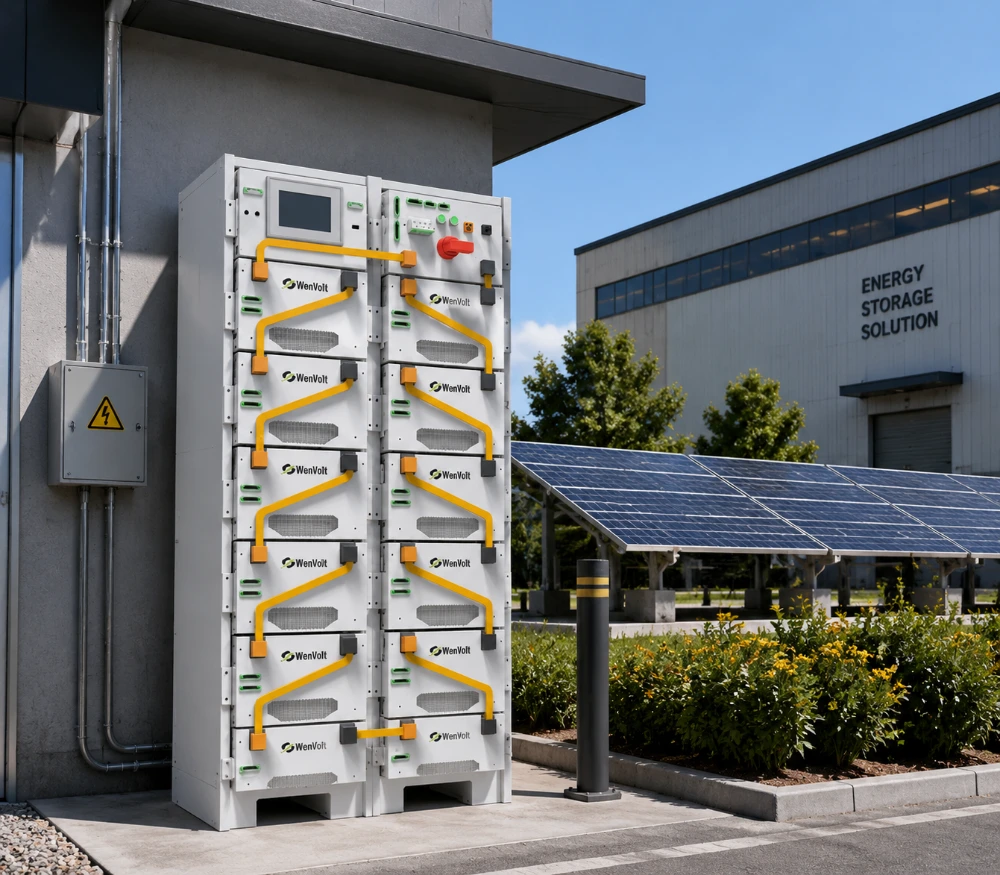
WonVolt’s industrial and commercial solution can be evaluated with an interval load profile and the duty cycle that creates heat. The design should state whether the cluster performs peak shaving, solar shifting, backup, or several jobs. A larger energy number does not remove the current and temperature limits that govern instantaneous power.
Use Thermal Spread as a Maintenance Signal
One alarm threshold is not enough for lifecycle management. Trend the maximum, minimum, and average temperature, spread, current, state of charge, and ambient conditions. Compare equivalent operating windows rather than comparing a summer high-power event with a winter idle period. A gradual increase at the same duty can be more significant than a single high reading during an unusual event.
Investigate Before Resetting an Alarm
When a thermal alarm appears, record the event before clearing it. Check recent power, cooling status, sensor plausibility, terminal condition, module balance, and external heat sources. Repeated resets can hide a developing connection or cooling fault. Maintenance decisions should distinguish sensor error from genuine thermal divergence and keep the evidence for the affected module or circuit.
A battery room also needs a practical response plan. Define who can isolate the equipment, how the area is kept clear, how emergency personnel receive information, and which measurements are required before restart. Temperature data is useful only when it leads to a controlled decision.
Verify the Cluster Under Representative Duty
Acceptance testing should include a controlled charge and discharge at several power levels, a rest period, communication checks, protection response, and a review of the hottest and coolest positions. Repeat the test after the cooling system reaches normal operation. Document the ambient condition and the time between events so later service comparisons use the same reference.
The WonVolt product portfolio and contact page support discussions based on site layout, load curve, grid rules, fire strategy, cooling, and maintenance access. The best specification explains how thermal data will be used during normal dispatch, alarm handling, and warranty evaluation.
Compare Charge and Discharge Asymmetry
A module may become the warmest during discharge and behave normally during charge, or the reverse. Compare the same current direction at similar state of charge and ambient temperature. The asymmetry can help narrow the cause to electrical resistance, cooling direction, balancing activity, or sensor placement. Keep enough pre-event rest time for meaningful comparison.
Set a Baseline Before Seasonal Operation
Commission the cluster at several repeatable power levels and record the location of the warmest and coolest sensors. Repeat under a different ambient condition when possible. The baseline should include cooling start and stop behavior, temperature spread after rest, and recovery time. Later maintenance can then compare like duty with like duty instead of reacting to one isolated high reading. Create separate baselines for charge, discharge, and rest at representative ambient temperatures.
FAQ
Q1: Why does temperature spread matter in a lithium battery cluster?
A: The warmest position may reach its current, voltage, or safety limit before the average temperature looks abnormal.
Q2: Can a high ambient temperature alone cause uneven cell temperature?
A: It can expose differences in airflow, resistance, module location, and cooling performance, so the pattern should be investigated rather than attributed to ambient heat alone.
Q3: What data should be trended with battery temperature?
A: Track current, voltage, state of charge, power command, ambient temperature, cooling status, maximum and minimum temperature, and the spread.
Q4: Does a BMS remove the need for thermal maintenance?
A: No. The BMS can monitor and protect within its design, but filters, fans, pumps, connections, sensors, and room conditions still require inspection.
Q5: How should a commercial battery cluster be tested before service?
A: Use representative charge and discharge levels, communication and protection checks, cooling operation, rest periods, and a documented baseline for temperature spread.