



A grid-following inverter works best when a stable grid already sets voltage and frequency. A grid-forming inverter can establish those references and support a weak grid or an islanded network. That distinction matters more than the headline power rating. Your choice affects black start, protection design, control coordination, fault response, commissioning, and the services a battery energy storage system can provide. Start with the operating scenario, then confirm the required grid code, short-circuit conditions, transition behavior, and controls with the inverter supplier and system integrator.
Key Takeaways
- Choose grid-following control when the point of connection is strong and the main job is scheduled charge, discharge, or peak management.
- Consider grid-forming control when the BESS must energize a dead bus, operate as an island, or stabilize a weak network.
- Do not treat “grid-forming” as a complete specification. Ask how the controls behave during faults, overloads, mode transfers, and parallel operation.
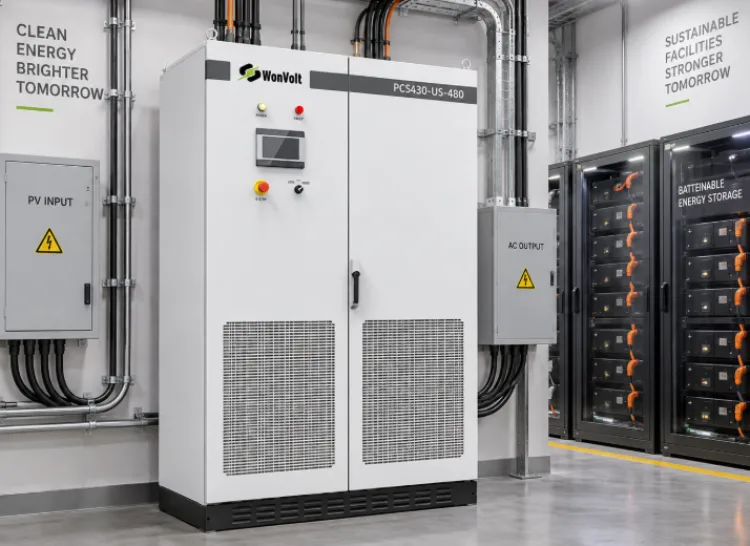
- Match the PCS, battery, EMS, transformer, switchgear, and protection scheme as one system.
The Practical Difference Is the Reference Signal
Both architectures convert DC battery power into AC power, yet they use different control assumptions. That difference becomes visible when the external network is disturbed or unavailable.
How Grid-Following Control Works
A grid-following inverter measures the existing AC waveform and synchronizes its output to it. A phase-locked loop commonly tracks grid angle and frequency. The controller then regulates active and reactive current according to dispatch commands. This approach is mature and efficient for a strong utility connection, where the network already provides a firm voltage and frequency reference.
The limitation appears when the reference becomes weak. A low short-circuit ratio, rapid voltage movement, or several interacting converters can make synchronization harder. A grid-following unit also cannot normally energize a dead bus by itself because there is no waveform to follow.
How Grid-Forming Control Works
A grid-forming inverter behaves more like a controllable voltage source. It establishes voltage and frequency within defined limits and changes power output in response to system conditions. Depending on the implementation, it may use droop control, virtual synchronous machine logic, or another vendor-specific method.
This capability can support an islanded microgrid, improve stability in a converter-heavy network, and enable black-start sequences. It does not remove the need for engineering. Current limits still apply, and inverter fault current differs from the high fault contribution associated with many rotating machines.
Match the Control Mode to the Operating Scenario
The right answer depends on what happens at the point of connection during normal operation and during the worst credible event.
Strong-Grid Peak Shaving
For a factory connected to a stable utility network, the BESS may charge during low-tariff periods and discharge during demand peaks. Grid-following control can be a practical fit because the utility grid remains the reference. The priority is often accurate dispatch, high conversion efficiency, and clean coordination with the site energy management system.
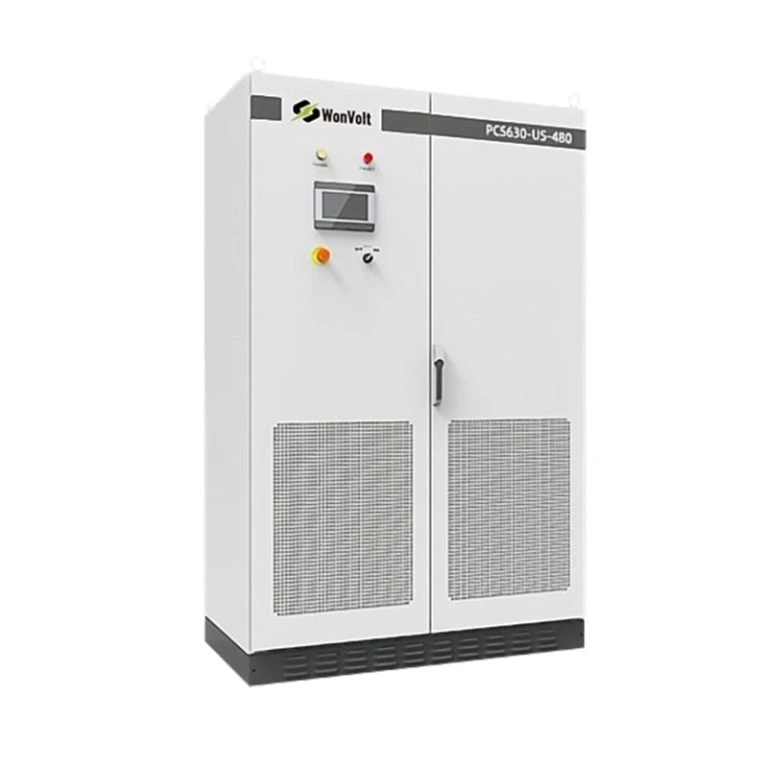
WonVolt lists bidirectional PCS options for battery storage projects, including a 100 kW to 1000 kW battery inverter. Confirm the current datasheet, applicable voltage window, overload behavior, communication protocol, and certification package for your destination market before selection.
Weak Grid or High Renewable Penetration
A remote industrial site may have a long feeder, limited short-circuit strength, large motor starts, or rapid renewable variation. Grid-forming control can help maintain a local reference, but the project team must model interactions among the PCS, generators, loads, and protection devices. The value lies in the complete control strategy, not in a label on one cabinet.
Island Operation and Black Start
If the site must keep critical loads alive after grid loss, define the transition sequence. Ask whether the system needs an uninterrupted transfer, a brief outage followed by restart, or only manual islanding. Black start also requires enough stored energy, auxiliary power for controls and cooling, a suitable energization sequence, and permission to close each breaker safely.
The industrial and commercial solution provides useful context for integrated project discussions. Your single-line diagram and operating philosophy should still govern the final equipment arrangement.
Compare the Project-Level Trade-Offs
A useful comparison looks beyond the converter brochure and examines engineering, operation, and lifecycle support.
| Decision Area | Grid-Following | Grid-Forming |
| External reference | Requires an established grid waveform | Can establish local voltage and frequency |
| Typical fit | Strong-grid dispatch and energy management | Weak-grid support, islands, and black start |
| Controls | Usually simpler to integrate | Requires deeper system coordination |
| Protection | Conventional assumptions may be easier to apply | Fault-current behavior needs careful study |
| Commissioning | Focus on synchronization and dispatch | Adds transition, stability, and parallel tests |
Grid-forming capability may increase controls work and testing effort. It can also create value when the alternative is a larger grid upgrade, extra rotating equipment, or unacceptable downtime. Compare those system costs instead of comparing PCS prices alone.
Five Checks Before You Issue an RFQ
Use the RFQ to make vendors describe observable behavior. Broad feature statements are difficult to verify during factory acceptance testing.
1. Define the Grid Strength
Provide the point-of-connection voltage, transformer data, expected short-circuit level, X/R ratio, and operating configurations. Include planned renewable generators and other converters.
2. State the Required Modes
List grid-connected charge and discharge, reactive-power control, island operation, resynchronization, and black start separately. A product may support some modes but not every transition between them.
3. Set Disturbance Tests
Specify voltage dips, frequency excursions, load steps, motor starts, communication loss, and emergency stop behavior. Ask which results can be witnessed at factory level and which need site testing.
4. Review Battery and PCS Limits Together
The battery management system may restrict charge or discharge power because of temperature, state of charge, cell imbalance, or alarms. The PCS cannot deliver a service that the battery cannot safely support. WonVolt presents broader utility-scale storage solutions for buyers who need to discuss this coordination at system level.
5. Confirm Responsibility for Tuning
Control parameters may need adjustment after connection. Put responsibility for models, studies, parameter approval, commissioning, and post-handover support into the contract. A clear interface list prevents the PCS supplier, EMS provider, and EPC from assigning the same problem to one another.
Field Cautions That Protect the Schedule
First, do not approve protection settings from a generic inverter fault-current assumption. Request the manufacturer’s time-dependent current behavior and validate it against the selected relays and breakers.
Second, do not leave mode-transfer testing until the final day of commissioning. Test the sequence in stages, with agreed pass criteria and a safe rollback plan. Auxiliary supplies, communications, transformer inrush, and load priority can all affect a transfer that looked simple in a control narrative.
For product and application questions, send the single-line diagram, load list, operating modes, and target grid code to WonVolt. That gives the technical team enough context to discuss a suitable architecture instead of guessing from a power rating.
Conclusion
Choose the control mode from the network and operating scenarios, then specify the transitions and tests. Grid-following control suits a stable external reference; grid-forming capability becomes relevant for weak grids, island operation, black start, and fast renewable variation. In either case, the PCS, battery, EMS, transformer, switchgear, protection, models, and tuning responsibility must be coordinated as one system.
Review the WonVolt PCS100 to 1000 US bidirectional inverter for the current product reference, then contact WonVolt. Send the single-line diagram, grid strength data, battery voltage range, required power, operating modes, fault and transition tests, communications, and destination codes to discuss a suitable PCS architecture.
FAQ
Can a grid-forming inverter operate while connected to a utility grid?
It can in a properly engineered system, but the control mode, grid-code requirements, and interaction with other sources must be verified for the specific project.
Does grid-forming control guarantee black start?
No. Black start also depends on stored energy, auxiliary power, switchgear, transformer energization, load sequencing, and the approved control logic.
Is a grid-following inverter unsuitable for every weak grid?
No. Suitability depends on network strength, controller design, other connected converters, and the results of system studies.
Can one BESS switch between grid-following and grid-forming modes?
Some systems can, but buyers should verify the supported transitions, interruption time, test evidence, and commissioning procedure.
What should a buyer send before requesting a PCS proposal?
A: Send the single-line diagram, battery voltage range, required power, grid data, operating modes, site conditions, communications, and applicable codes.