



In 2026, the cost of a solar project is shaped less by the panel price alone and more by the full installed system: modules, inverter, mounting, labor, permitting, electrical work, financing, and site conditions. In the U.S., recent industry benchmarks place residential systems around the low-to-mid $3 per watt range before local incentives. A 6 kW system may therefore be quoted near $18,000–$22,000, although roof work, batteries, and local labor can move the number higher. Savings depend on how much electricity you offset, the retail rate you avoid, export compensation, and whether you pay cash or finance.
This updated 2026 guide separates module cost from total installed cost, shows how to estimate bill savings and payback, and explains where WonVolt bifacial modules fit. The goal is not to promise one universal return. It is to help you compare quotes with the same assumptions and avoid choosing a high-wattage panel that does not match the roof, racking, inverter, or project scale.
What Factors Shape Solar Panel Costs in 2026
Installed System Price Matters More Than the Panel Price
The panel itself is only one line item. In 2026, U.S. residential system pricing has eased year over year as module and customer-acquisition costs fell, but the final quote still includes the inverter, racking, wiring, labor, design, permits, inspection, and contractor margin. A low module price does not guarantee a low installed price. Compare quotes in dollars per watt on the same DC system size and confirm whether tax, interconnection, roof reinforcement, monitoring, and battery storage are included.
Labor, Permitting, Roof, and Grid Conditions
Labor and soft costs vary by market. A simple roof with a modern electrical panel may be straightforward, while tile roofing, a steep pitch, shading, a service-panel upgrade, or long cable runs can add thousands of dollars. Commercial projects also face structural reviews and more complex interconnection work. Ask each installer to separate hardware, labor, permit, electrical-upgrade, and financing charges so you can see why two quotes for the same kW size differ.
Module Efficiency, Wattage, and Balance-of-System Costs
Higher-wattage modules can reduce the number of panels, clamps, connectors, and racking points required for a target capacity. That can lower balance-of-system and installation costs on large commercial or utility projects. It does not automatically make the module suitable for a home roof. Dimensions, weight, current, wind loading, handling limits, and inverter compatibility matter as much as the wattage printed on the label.
How Do Solar Panels Deliver Long-Term Savings in 2026
Electricity Offset Creates the Core Saving
Start with annual usage and the retail electricity rate. At the U.S. residential average of about 18.83 cents per kWh in April 2026, offsetting 800 kWh in a month is worth roughly $151 before fixed utility charges and export rules. A system that offsets 9,600 kWh a year would avoid about $1,808 at that rate. Your result may be much higher or lower because utility prices, self-consumption, seasonal production, and net-metering or net-billing rules vary.
Incentives Changed in 2026
For U.S. homeowners, the 30% federal Residential Clean Energy Credit is no longer available for expenditures made after December 31, 2025. That makes state rebates, utility incentives, property-tax treatment, local financing, and export compensation more important in 2026. In other countries, support may come through rebates, feed-in tariffs, low-interest loans, or tax relief. Verify the program before signing because eligibility, deadlines, and approved equipment lists can change.
Payback Depends on Cash Flow, Not a Single Headline Number
A simple payback calculation divides net upfront cost by first-year net savings, but a better model also includes electricity-price changes, annual degradation, inverter replacement, maintenance, financing interest, insurance, and export rates. Without the former U.S. federal residential credit, many 2026 projects may need a longer payback period than similar 2025 installations. High electricity prices, strong self-consumption, good solar exposure, and low financing costs can still produce attractive results.
Where Do Bifacial Solar Panels Deliver the Best Value
Rear-Side Generation Needs Reflected Light
Bifacial modules collect direct light on the front and reflected light on the rear. The extra yield depends on albedo, row spacing, mounting height, tilt, and shading behind the module. White membranes, concrete, gravel, snow, and open ground can improve rear-side contribution. A panel installed close to a dark roof with little rear clearance may capture far less additional energy.
Bifacial Does Not Automatically Mean Better Low-Light Output
Cloudy-day performance is mainly influenced by cell technology, spectral response, temperature behavior, and system design. The bifacial feature adds value when useful light reaches the rear surface; it is not a guarantee of a fixed percentage gain on every roof. When comparing proposals, ask the designer to show the assumed bifacial gain in the energy model and the site conditions used to justify it.
Higher Lifetime Yield Can Reduce LCOE
When a site supports meaningful rear-side generation, bifacial modules can produce more kilowatt-hours from the same DC nameplate capacity. That can lower levelized cost of electricity, especially in commercial and utility projects where layout and ground surface can be optimized. The ROI should still be calculated from modeled annual energy, installed cost, degradation, curtailment, and operating expenses rather than wattage alone.
What Makes the WonVolt 600W Bifacial Panel a Practical C&I Choice
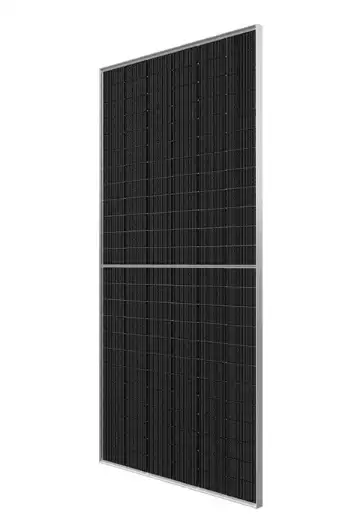
Bifacial Solar Panel 600W WV-72KUN605-H8NS
The 600W module is part of the WV-72KUN series for commercial and industrial power plants. The series reaches a maximum output of 605W and up to 23.4% module efficiency. Its N-type TOPCon design, 16BB cell technology, and bifacial construction are intended to increase energy yield while keeping LCOE under control.
Project Fit, Dimensions, and Electrical Design
The WV-72KUN605-H8NS measures 2278 × 1134 × 30 mm and weighs 31.8 kg. Those figures make it more suitable for commercial roofs and ground-mounted projects than for small residential roofs with tight access. Its 44.00 V maximum-power voltage and 13.75 A maximum-power current at STC must be checked against string length, inverter MPPT range, connector rating, and cable design.
Dual-Glass Construction and Mechanical Loading
The module uses 2.0 + 2.0 mm heat-strengthened dual glass, an anodized aluminum frame, and an IP68 junction box. The listed static load ratings are 5400 Pa on the front and 2400 Pa on the rear, with a 25 mm hail test at 23 m/s. WonVolt states a 30-year linear power output warranty for this N-type TOPCon series; buyers should confirm the current product-warranty terms in the final datasheet and supply contract.
How Does the WonVolt 750W Bifacial Panel Support Utility-Scale ROI
Bifacial Solar Panel 750W WV-66KUN740-H12NS
At 750W, the Bifacial Solar Panel 750W WV-66KUN740-H12NS is positioned for utility-scale power stations, where fewer modules per megawatt can reduce repetitive installation work, racking points, connectors, and land-use pressure.
Advanced MBB 210mm Cell Technology
The WV-66KUN series uses large-format 210 mm cells and multi-busbar interconnection to reduce resistive losses and support high current output. For project developers, the practical benefit is a higher DC capacity per module. The electrical design must account for current limits, string configuration, inverter loading, cable sizing, and tracker or fixed-tilt compatibility.
N-Type TOPCon, Bifacial Yield, and LCOE
N-type TOPCon technology supports high conversion efficiency, a favorable temperature coefficient, and low long-term power loss. Combined with dual-glass bifacial construction, it can improve lifetime energy yield in open, reflective sites. For ROI calculations, use the current project datasheet and simulation file rather than applying a generic 5%, 10%, or 20% gain to every location.
What Are the Key Trends in Solar Panel Pricing for 2026
Module Prices Fell, but Total Project Costs Did Not Move Equally
SEIA and Wood Mackenzie reported that distributed-generation module prices were more than 20% lower year over year in Q1 2026, while residential system pricing fell 7%. Commercial system pricing, however, rose 4% as electrical and structural balance-of-system costs increased. This split explains why buyers may see cheaper panels but not an equally large reduction in the final EPC quote.
Electricity Prices Strengthen the Savings Case
U.S. residential electricity prices averaged 18.83 cents per kWh in April 2026, 7.3% above the previous April. Higher grid prices increase the value of each solar kilowatt-hour used on site. The effect is strongest when the load profile matches daytime production or storage shifts surplus energy into evening demand.
High-Wattage Modules Continue Moving Toward C&I and Utility Projects
The 600W and 750W classes are most valuable where handling equipment, roof structure, racking, and electrical design can accommodate large modules. For small homes, a lower-wattage full-black module may fit roof geometry and aesthetics better. The correct choice is the one that produces the best system-level yield and cost, not simply the highest panel rating.
How Can You Select the Right Solar Panel Solution in 2026
Size the System from Annual Consumption and Solar Yield
If you use 10,000 kWh a year, divide that demand by the expected annual yield per installed kilowatt. At 1,200 to 1,500 kWh per kW-year, a first-pass system size is about 6.7 to 8.3 kW before adjusting for shading, export limits, future loads, and self-consumption. That could be around 11 to 14 units in the 600W class or 9 to 12 units in the 750W class, but physical and electrical fit must be verified.
Check Roof Area, Handling, Structure, and Inverter Limits
A module count alone is not a design. Confirm usable roof area, setbacks, access paths, fire rules, structural loading, wind and snow zones, crane or lifting needs, and inverter voltage and current limits. Utility-scale buyers should also compare tracker compatibility, container loading, installation speed, degradation, warranty bankability, and expected bifacial gain.
Requesting a Project-Specific Comparison from WonVolt
Before selecting a module, send annual load, site location, available area, mounting type, grid voltage, inverter plan, wind and snow requirements, and target capacity. A useful proposal should compare installed cost per watt, modeled first-year production, specific yield, performance ratio, degradation assumptions, and levelized cost of electricity. This makes the 600W and 750W options easier to evaluate on the same basis.
FAQs
Q1: How long does it take for solar panels to pay for themselves in 2026?
There is no universal period. Cash purchases in high-rate markets with good sun and local incentives may recover cost in roughly 7–10 years, while financed projects or sites with weak export compensation can take longer. Use net project cost divided by realistic annual net savings, then test electricity inflation, degradation, and financing.
Q2: Is the 30% U.S. federal residential solar tax credit available in 2026?
No. The IRS states that the Residential Clean Energy Credit is not available for expenditures made after December 31, 2025. State, utility, and local programs may still apply.
Q3: Do bifacial solar panels work equally well on every roof?
No. Bifacial panels perform best when the rear side has clearance and receives reflected light. Flush-mounted dark roofs may deliver limited rear gain, while white commercial roofs, carports, and ground-mounted arrays can provide better conditions.
Q4: Which WonVolt module class fits residential, C&I, and utility projects?
The 600W WV-72KUN605-H8NS is positioned for commercial and industrial projects, while the 750W WV-66KUN740-H12NS is aimed at utility-scale applications. Small residential roofs may be better matched to a lower-wattage module with easier handling and better roof-layout flexibility.
Q5: What warranty terms should a buyer verify?
Check both the product warranty and the linear power output warranty in the current datasheet and contract. WonVolt’s N-type TOPCon product pages state a 30-year linear power output warranty, but the exact product-warranty period, degradation schedule, claim process, and exclusions should be confirmed for the ordered model.
Conclusion: What Solar Buyers Should Focus on in 2026
In 2026, the strongest solar decision comes from matching a realistic energy model to the full installed cost. Module prices may be lower, but incentives, electricity rates, labor, balance-of-system costs, financing, and site design now have a larger effect on payback. Compare products by annual kilowatt-hours, physical fit, electrical compatibility, warranty terms, and LCOE. A high-wattage bifacial module can improve project economics when the site supports it, but the best ROI comes from a complete system that uses the available sunlight and the generated electricity efficiently.