




Calling a battery “VPP-ready” is easy. Making remote dispatch work at a live commercial site takes more than an open communication port.
The outside platform will ask for power at a certain time. From there, the local controls have a less tidy job: check the meter limit, watch the factory load and see what the battery can safely do at that moment. Until those choices have named rules, a smart-looking dashboard proves very little.
First draw the dispatch boundary
Put the single-line diagram on the table. Mark the meter that the VPP will be judged against. Then mark the equipment it may influence.
That drawing soon shows where the awkward questions sit. Perhaps the battery may export; perhaps its job stops at reducing grid import. A controllable office load may also be available, while a production line stays completely outside the VPP’s reach. Those differences belong on the drawing.
A commercial storage cabinet normally brings the battery packs and their BMS together with the EMS, PCS, cooling and fire protection. Charging or discharging is coordinated through that local equipment. This overview of how BMS, PCS and EMS work together explains the roles in more detail. In practice, a cloud request passes through these layers; it never speaks directly to the cells.
The EPC should put that boundary in the control description, not leave it as an assumption.
The nameplate is not the dispatch offer
Installed energy and available energy are not the same number.
Part of the battery may be held for backup. The site may have an export cap. The usable window also moves with temperature, SOC and local protection limits. Ten minutes at high power and two hours at a modest setpoint may look similar in an energy schedule, but they ask different things of the battery.
So before anyone promises capacity to a virtual power plant, collect the site’s real limits. Note the permitted import and export, the usable power and energy for this configuration, the minimum reserve, the likely event length and the recharge window afterward.
That recharge window deserves its own line. After a demand response event, a fast recovery charge can create the very peak the battery was meant to avoid. It can also leave too little room for the next solar period.
Ask for the actual points, not a protocol logo
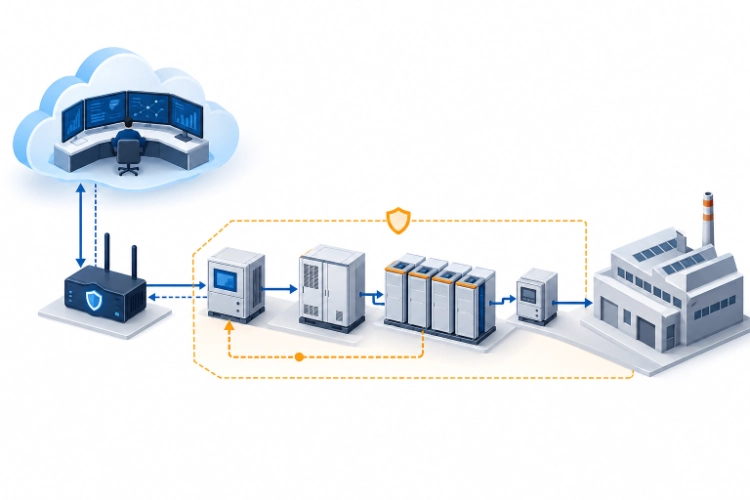
General EMS architecture gives a useful starting point. An EMS may collect live data from the PCS, BMS, meter, air conditioning, fire system and site loads. Ethernet, RS485 and CAN are commonly used. The EMS can process those inputs for displays, alarms, records and remote commands.
For commissioning, “supports RS485” is still a thin answer.
The EPC needs the protocol version and the point list for the supplied project. Units, scaling, refresh rate and read or write access should sit beside each point. One small item deserves a red pen: the sign convention. Discharge shown as positive at one end and negative at the other can reverse a perfectly valid command.
Write permissions need a separate review. Which party may start or stop the battery? Can the VPP change an active-power setpoint only, or can it also change operating mode? Who may clear a fault? The safest answer is usually that a remote request remains subject to local limits, but the documents have to say so.
Set command priority before testing
Commercial sites often have several control goals running together: peak shaving, solar self-use, backup reserve and now VPP dispatch. The coordination issues are similar to the checks used when BESS controls work with a site microgrid. At some point, two goals will disagree.
Suppose the VPP requests discharge while the local EMS is protecting an export limit. The project needs one agreed winner. The same applies when the site operator presses stop, when the fire system is active, or when the BMS reduces the available charge or discharge power.
The BMS remains inside the battery protection boundary. Real-time BMS data can be used by the EMS to adjust upper and lower charge and discharge limits, helping avoid overcharge, over-discharge and repeated deep cycling. No outside schedule should be written as though it can step around that protection.
Avoid putting an unsupported default SOC range into the specification. The reserve and operating window belong to the actual design. What can be settled early is ownership: who sets the reserve, who may change it and which need takes priority during an event.
Decide what a lost connection means
Communication will fail sooner or later, even if only for a short period. The system needs a boring, predictable response.
Should it hold the last setpoint for a few seconds? Return to the local schedule? Ramp to zero and wait? There is no single answer for every site. There does need to be an answer for this one.
Set a command timeout. Define the fallback state and the recovery step. Confirm whether a returning connection resumes automatically or waits for acknowledgement. Then check the event logs from the VPP, EMS, PCS and meter. Their clocks need to agree, or fault investigation turns into an argument about timestamps.
Remote access should be covered in the same package. Record who issues credentials, how write actions are logged and how access is removed when a service contract ends.
Run an awkward commissioning test
A test that sends one setpoint and gets one response proves the easiest part.
Use a sequence closer to real operation. Begin on the normal local schedule. Send a discharge request. Change the site load while the request is active. Raise the requested power above the allowed value. Drop the communications link, restore it, finish the event and watch the recharge.
The expected result should be written before the test. When a request is rejected, the VPP operator needs a usable reason. “Command failed” is not much help; “SOC reserve active” or “site export limit reached” is.
FAT is suitable for simulated points, command handling and alarm logic. SAT must use the real meter, network and operating limits. Keep both records with the handover documents.
Put the gaps on the purchase order
Battery supplier, PCS supplier, EMS integrator, VPP provider and EPC may all touch the same control chain. That is exactly why responsibilities get missed.
The order or interface schedule should name the party that provides the point list, gateway, remote-access setup, logic changes, FAT, SAT, training and post-handover fault support. It should also say who updates the interface when either platform changes software.
Ask for exclusions in plain words. If VPP integration is outside the battery supplier’s scope, the EPC can price a gateway and integrator. A vague “compatible” note is harder to plan around.
WonVolt can discuss the battery-side requirements of a commercial storage project with the buyer and EPC. The chosen VPP platform and site controller still need a project-specific interface review. A related control issue is covered in How Does Reactive Power Control Impact C&I Battery Storage Performance?.
Conclusion
A workable VPP connection starts with limits and responsibility, not with a cloud screen. Fix the meter boundary, dispatch window, command priority and loss-of-communication response. Test the uncomfortable cases as well as the normal one.
Once those points are signed off, remote dispatch becomes a manageable site function. Without them, “VPP-ready” is only a label.
FAQ
What should an EPC request before VPP integration starts?
Request the single-line diagram, meter boundary, import and export limits, usable power and energy, SOC reserve, protocol and point lists, command priority, fallback behavior and acceptance-test plan. Give every item an owner.
Can a VPP bypass the BMS to meet a dispatch request?
No. The BMS remains part of the battery protection boundary. The EMS can use live BMS data to adjust the permitted charge and discharge range, and the remote request has to stay inside it.
Is Ethernet, RS485 or CAN support enough for VPP control?
No. The project still has to match data points, units, write rights, timing, security, command priority and the response to a broken connection.