



A practical framework for comparing usable energy, power, safety, compatibility, operating conditions and expansion options.
Choosing the best battery for a solar energy system starts with the load profile, not the battery label. A suitable battery must store enough usable energy for the intended backup or self-consumption period, deliver the required peak power, match the inverter’s voltage and communication requirements, and operate safely in the installation environment.
The right choice is therefore a system decision. Battery chemistry, nominal capacity, usable capacity, depth of discharge, cycle life, thermal conditions, and future expansion all need to be checked together.
Start with the job the battery must perform
Solar batteries are used for different operating objectives:
- Backup power:keep selected loads running when the grid fails.
- Self-consumption:store daytime solar production for evening and night loads.
- Peak shaving:reduce the amount of power purchased from the grid during expensive or high-demand periods.
- Off-grid operation:supply loads without a stable utility connection.
These objectives produce different sizing results. A home that needs several hours of backup for lights, refrigeration, communications and essential sockets may need a different battery than a factory that wants to reduce a short, high-demand peak. Write down the loads, their running power, starting power, operating hours and priority before comparing products.
Compare usable energy instead of nominal energy
The nameplate energy is not always the energy that can be delivered to the loads. A practical first estimate is:
Required nominal battery energy ≈ daily energy to be shifted or backed up ÷ target usable fraction ÷ system efficiency
For a backup system, calculate the energy of the protected loads during the planned outage window. For a self-consumption system, use the solar energy that would otherwise be exported and the evening or night demand that the battery is expected to cover.
Depth of discharge (DoD) matters because repeatedly using the full nameplate capacity can affect operating life. Compare the manufacturer’s stated usable energy and recommended DoD under the same test conditions. A larger nominal battery is not automatically better if the system cannot use its capacity, the inverter cannot charge it fully, or the load profile rarely needs it.
Match power with the real load profile
Energy answers “how long?” Power answers “how much at one time?” A battery system can have enough kWh for an overnight period and still fail to start a pump, compressor or motor if its discharge power is too low.
Check three values separately:
- Continuous discharge power for the normal load.
- Short-duration or surge power for motor starting and other transient loads.
- Inverter output power, which may be lower than the battery’s theoretical discharge capability.
For commercial systems, also check whether the battery and power conversion system can sustain the required charge and discharge rate. WonVolt’s industrial and commercial solution pages position storage for backup power, peak shaving and self-consumption. The battery, PCS and site control strategy must be selected as one operating package.
Select chemistry and safety features for the installation
Lithium iron phosphate (LiFePO4) is widely used in stationary solar storage because it combines high usable energy with a stable operating profile. Chemistry alone does not define safety. The battery management system, cell quality, enclosure, protection devices, installation clearances and operating controls are equally important.
Ask for the following before approval:
- Cell chemistry and cell grade
- Battery management system functions
- Over-voltage, under-voltage, over-current and short-circuit protection
- Operating and storage temperature range
- Cooling method and ventilation requirements
- Transport and safety documentation
- Applicable product certificates and test reports
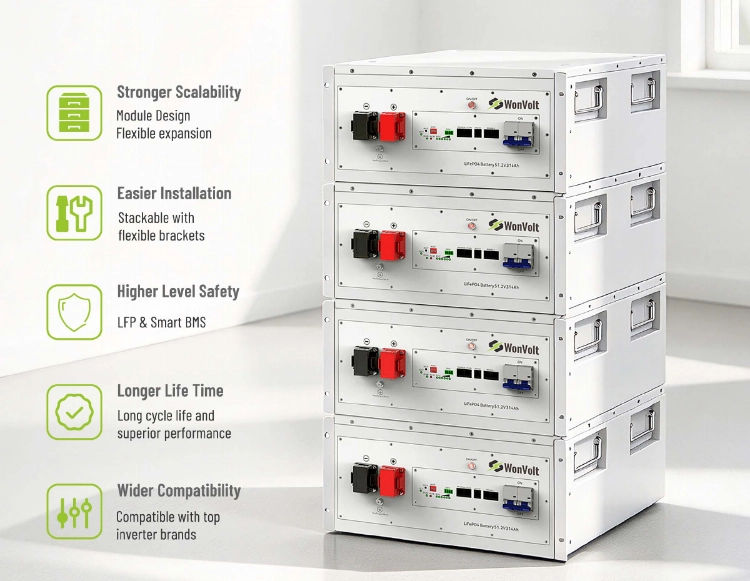
The WV51314L Wheel and Stackable datasheets list LiFePO4 cells, a smart BMS and over-current, over-voltage, short-circuit and under-voltage protection. Both versions list a 90% maximum recommended DoD, 10,000 cycles, a 10-year warranty and a 15-year design life. Their communication options include Bluetooth, Wi-Fi, RS485, RS232 and CAN. Confirm the certificates and installation requirements for the exact version being quoted.
Check inverter voltage and communication compatibility
Compatibility is more than matching a battery’s kWh rating. Confirm:
- Battery voltage range and inverter DC input range
- Maximum charge and discharge current
- Start-up and shutdown voltage behavior
- CAN, RS485 or other communication protocol
- Approved inverter list and firmware requirements
- Parallel connection limits
- Grounding, isolation and protection arrangements
The WV51314L Wheel and Stackable sheets list 51.2 V nominal voltage, 314 Ah capacity, 16.07 kWh nominal energy and 14.463 kWh usable energy per battery. The operating range is 44.8–57.6 V, with a 57.6 V maximum charge voltage, a recommended 0.5 C charge/discharge rate and up to 200 A maximum charge/discharge current. Both versions allow up to 16 units in parallel and list 90% maximum recommended DoD. The Stackable version allows up to four units stacked; confirm the selected format and inverter compatibility before ordering.
WonVolt’s commercial offering is stated as 100 kW–261 kWh. For high-voltage projects, the WV51314H sheet lists a 51.2 V, 314 Ah LiFePO4 battery with 16.07 kWh nominal and 14.463 kWh usable energy per module. The module operating range is 44.8–57.6 V; maximum charge/discharge current is 157 A and the recommended rate is 0.5 C. The sheet also lists smart air cooling, 90% maximum recommended DoD and 10,000 cycles. Its system table shows 160.74 kWh nominal (144.666 kWh usable) for 12 modules in series and 241.15 kWh nominal (217.035 kWh usable) for 15 in series. The PCS window, series arrangement, protection coordination and site derating need to be confirmed for the project.
Size for temperature, location and maintenance access
Battery performance changes with temperature. A design that works in a mild indoor room may need different controls, cooling or enclosure protection in a hot, humid or dusty location.
Before selecting a model, record:
- Indoor or outdoor installation
- Lowest and highest ambient temperature
- Humidity and condensation risk
- Dust, salt, corrosive gas and flood exposure
- Fire separation and access requirements
- Cable route, lifting path and service space
Do not place a battery in a sealed, unventilated space simply because the nameplate fits. Check the manufacturer’s operating range and cooling method, then allow space for inspection, replacement and emergency isolation.
Plan expansion around the inverter and control system
Some projects begin with a small battery and grow later. Expansion is possible only when the battery modules, BMS, inverter, protection equipment and software support it.
Confirm whether future parallel units must be the same model, batch or firmware version. Also check whether the existing inverter can handle the higher current and whether the protection scheme must be redesigned. A modular battery that cannot be integrated into the original control architecture may cost more to expand than a correctly sized system installed from the start.
For a residential low-voltage application, the WV51314L is a 16 kWh-class battery: its datasheet lists 16.07 kWh nominal and 14.463 kWh usable energy, with up to 16 units in parallel. The commercial product range is stated as 100 kW–261 kWh. The WV51314H sheet gives its own system configurations, so confirm the exact battery arrangement and usable energy in the project quotation.
Use a procurement checklist before comparing quotations
| Decision item | What to verify |
| Energy | Nominal kWh, usable kWh, DoD and efficiency test conditions |
| Power | Continuous output, surge output, charge/discharge current and PCS rating |
| Compatibility | Voltage window, communication protocol, approved inverter list and firmware |
| Life | Cycle-life test condition, calendar-life statement and warranty boundaries |
| Safety | BMS functions, protection layers, certificates, enclosure and installation rules |
| Environment | Temperature, humidity, IP rating, cooling and derating |
| Expansion | Maximum parallel units, cable/protection changes and software limits |
| Service | Commissioning, remote support, spare parts, training and response process |
The lowest quoted price can hide a mismatch in usable energy, power capability, installation work or after-sales requirements. Compare the complete operating system and the evidence supplied for each claim.
When a home battery and a commercial battery need different priorities
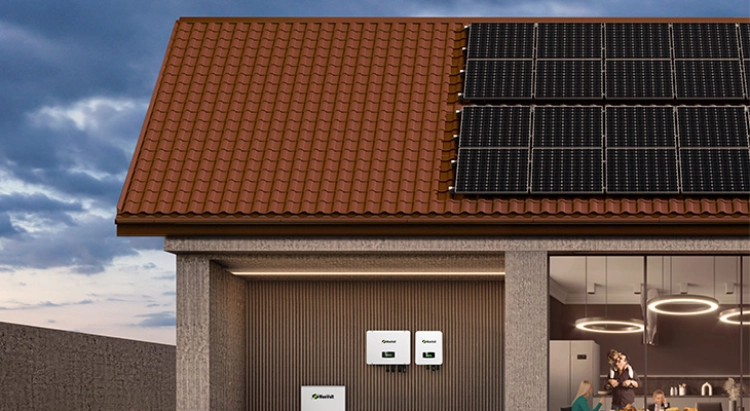
Home systems usually prioritize quiet operation, compact installation, backup circuits, simple monitoring and compatibility with a residential hybrid inverter. The WonVolt home solution covers on-grid, off-grid and hybrid use cases and links to residential battery products such as the 16 kWh WV51314L battery.
Commercial systems place more weight on power quality, peak-shaving schedules, demand charges, parallel operation, thermal management, service access and integration with a PCS or energy management system. WonVolt’s industrial and commercial solution presents storage for offices, schools, hospitals, supermarkets and factories. Its 100 kW–261 kWh commercial battery system and 100 kW–1 MW bidirectional PCS are examples of equipment that require project-level electrical design.
Frequently asked questions
How many kWh of battery storage does a home need?
There is no universal home battery size. Add the energy used by the loads that must remain powered during the selected backup period, then adjust for usable DoD, inverter efficiency, temperature and reserve capacity. Separate essential loads from flexible loads before asking a supplier to size the system.
Is a higher voltage solar battery always better?
No. Higher-voltage systems can reduce current for a given power level, but the correct voltage depends on the inverter, battery architecture, protection equipment, installation rules and service capability. A low-voltage battery can be a practical choice for a residential system when its voltage range and communication protocol match the inverter.
What should I ask a solar battery supplier before ordering?
Request the current datasheet, usable energy, power limits, DoD, cycle-life test condition, operating temperature, cooling method, BMS and communication details, certificates, warranty terms, approved inverter list and installation requirements. Ask the supplier to confirm the complete battery-inverter configuration in writing.