



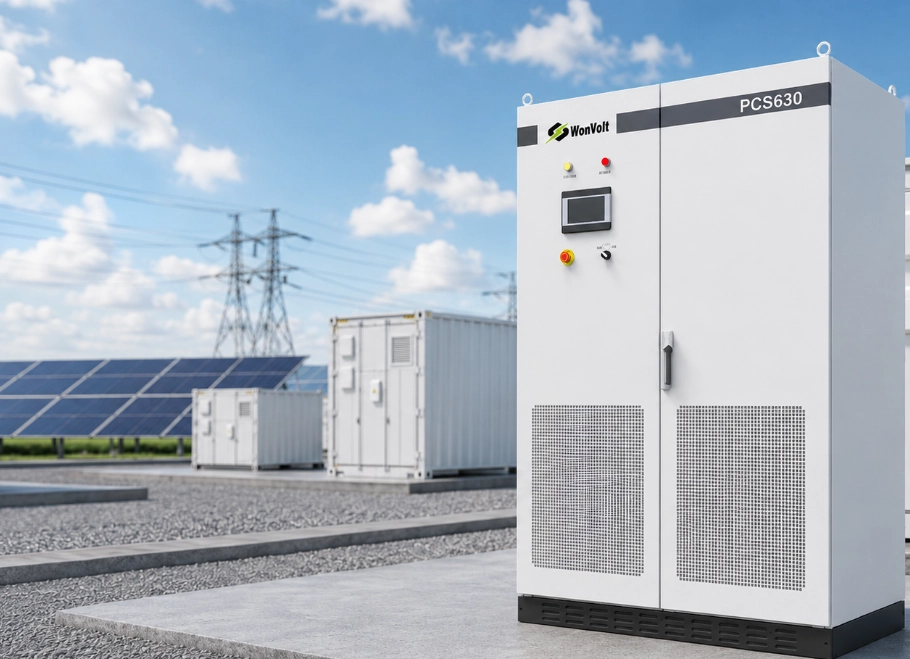
A bidirectional power conversion system, or PCS, is the electrical bridge between a battery and an AC power network. It converts AC electricity into DC electricity when the battery charges, then converts stored DC electricity back into AC electricity when the battery supplies a load or sends power to the grid. It also controls voltage, current, frequency, and operating mode. Without a suitable PCS, a battery can store energy but cannot deliver it safely or at the required power.
The PCS is therefore a critical BESS design choice. A poorly matched unit can restrict power, increase conversion losses, cause communication faults, or fail to support important loads during a grid interruption. A correctly selected PCS helps reduce peak demand, use more renewable electricity, protect power quality, and support expansion.
WonVolt develops equipment and integrated clean energy solutions for industrial, commercial, and utility-scale projects. Founded in 2016, it operates two factories in Hefei and reports capacities of 1.2GW for solar panels and 2.5GWh for lithium batteries. More details appear in the WonVolt company profile.
What Does a Bidirectional PCS Actually Do?
“Bidirectional” refers to two-way energy flow. The PCS changes direction according to commands from the energy management system while staying within limits supplied by the battery management system.
AC-to-DC Charging
When charging, the PCS/Rectifier converts AC current to DC current and regulates the DC current to the corresponding battery voltage. The BMS sets limits based on various parameters, such as the state of charge, temperature, cell voltage, current, and fault status. The BMS allows for accurate control of the battery to prevent overcurrent, overvoltage, and other events that can cause the battery to be stressed or even shut down. The BMS also allows for charging when there is low tariff or when the renewable energy output is greater than the site demand.
DC-to-AC Discharging
During discharge, the PCS works as an inverter. It converts battery DC electricity into AC electricity with the voltage, frequency, waveform, and phase required by the load or grid connection point.
This supports peak shaving, backup power, renewable energy shifting, and grid services. In industrial applications, response speed and overload performance can determine whether motors, pumps, compressors, and production controls continue operating normally.
Control with the BMS and EMS
The BMS monitors battery condition, while the EMS evaluates demand, prices, renewable generation, and operating priorities. The PCS receives the power command, checks battery limits, and performs the required charge or discharge.
Communication compatibility is essential. Incorrect protocols, data mapping, or fault logic may reduce available output or create repeated alarms. Common interfaces include CAN and RS485.
Why Is the PCS Critical to Modern BESS Design?
Battery capacity and PCS power describe different parts of performance. Capacity tells you how much energy can be stored. PCS power tells you how quickly that energy can be moved.
It Matches Power with Operating Duration
A large battery paired with an undersized PCS cannot discharge fast enough during a short demand peak. An oversized PCS adds cost if the battery cannot provide the required current.
A 1MWh battery paired with a 250kW PCS can theoretically discharge at rated power for about four hours before losses and operating limits are considered. A 500kW PCS delivers more power for a shorter period. The correct ratio depends on your required power and duration.
It Protects Power Quality
Sensitive loads need stable voltage and frequency, not just available energy. Harmonic distortion, power factor range, overload capability, and off-grid voltage control should be checked before purchase.
Inductive loads can draw high starting current. Weak overload control may cause failed starts, trips, or repeated restarts.
It Enables Different Operating Modes
Modern BESS projects may switch between grid-connected, off-grid, backup, and microgrid modes. The PCS controls the transition and determines how quickly the battery supports the load after a grid failure.
For industrial and commercial energy storage, common goals include backup power, peak shaving, and higher self-consumption. Larger projects may also smooth renewable output and operate several PCS units in parallel.
Which Buyer Problems Does a Well-Matched PCS Solve?
Its rating should follow the site problem and operating goal, not simply the largest available model.
High Peak Demand
A battery can be charged when the price of electricity is low, e.g. at night-time when there is a surplus of renewable power. Then it can be discharged at peak times. The PCS has to act fast enough and provide sufficient power to prevent unwanted demand peaks.
Review interval load data because monthly averages can hide short, expensive peaks.
Low Renewable Self-Consumption
Renewable generation and site demand rarely match throughout the day. A bidirectional PCS stores surplus energy and releases it when demand rises or generation falls.
Confirm whether the system uses AC coupling, DC coupling, or a hybrid architecture because each changes the conversion path and protection design.
Downtime and Expansion Risk
A single PCS can become a bottleneck. Parallel architecture can improve redundancy because other units may continue working while one unit is isolated, depending on the final control and protection design.
Modularity also lets you install the power required today and reserve space, switchgear, cabling, and controls for later expansion. This reduces early overinvestment and avoids a complete redesign when the facility grows.
How Does the PCS100-1000 Support Scalable BESS Projects?
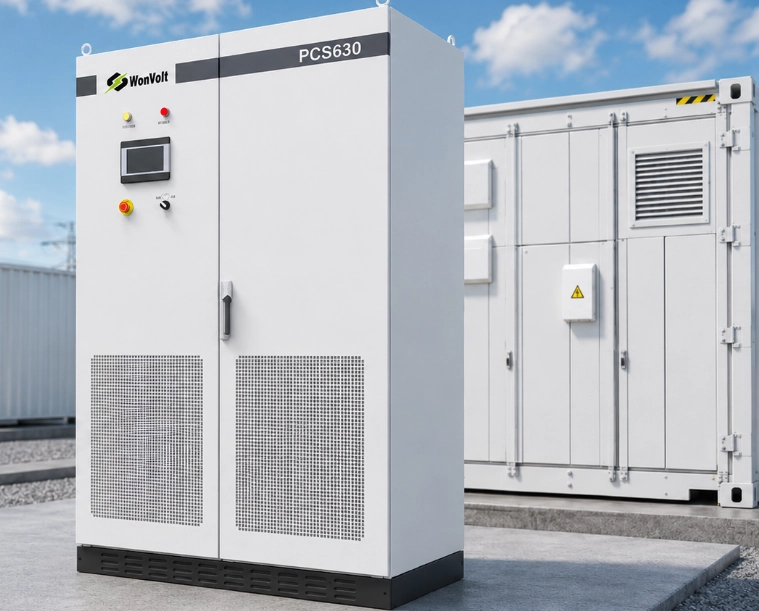
A featured product from the supplied list is the 100KW-1000KW Battery Inverter Bidirectional PCS100-1000. The series covers power levels from 100kW to 1000kW and supports up to eight units in parallel, allowing the conversion stage to expand with the load.
Efficiency and Power Quality
The 500kW and 1000kW configurations reach maximum efficiency of up to 98.5%. On-grid current harmonic distortion is below 3%, while off-grid voltage harmonic distortion is no more than 2% under linear loads.
Backup and Communication
The series supports an optional automatic transfer of no more than 10ms, which can help maintain selected critical loads after a grid failure. CAN and RS485 communication support integration with battery and energy management controls.
Battery and Site Matching
Determine the required battery voltage for your chosen model. 500V to 900V is covered by lower power models, while higher power models are covered by 900V to 1500V models. For more information on this series, including forced-air cooling and operation at temperatures from -25°C to +55°C, view the specifications against your battery, installation room, altitude, ventilation and load profile.
A factory may use it for peak shaving and backup, while a renewable energy plant may use it to shift generation. For larger projects, the utility-scale BESS solution combines batteries, inverters, temperature control, safety protection, and monitoring in a containerized architecture.
What Should You Check Before Selecting a PCS?
A data sheet defines equipment limits, but it does not define the correct project. Start with your load profile, battery characteristics, operating objective, environment, and expansion plan.
Power and Load Requirements
Review continuous load, maximum demand, motor starting current, target peak reduction, and backup priorities. Separate critical loads from noncritical loads.
Battery Compatibility
Check the full battery voltage range, maximum current, state-of-charge limits, and low-temperature behavior. Compatibility must remain valid at both the highest and lowest operating voltage.
System Communication
Confirm protocols, registers, commands, alarms, and master-control responsibility. Test charging, grid loss, emergency stop, communication failure, recovery, and parallel-unit faults.
Installation Conditions
Check temperature, humidity, altitude, dust, ventilation, noise, enclosure protection, transformer needs, cable distance, and maintenance access.
WonVolt offers tailored energy solutions, including pre-design field investigation, installation support, commissioning, and technical training. Project information can be submitted through the contact page so the PCS, battery, protection, and control architecture can be evaluated together.
FAQ
Q1: Is a Bidirectional PCS the Same as a Normal Solar Inverter?
A: No. A normal solar inverter mainly converts photovoltaic DC electricity into AC electricity. A bidirectional PCS also converts AC electricity into DC electricity for battery charging.
Q2: How Do You Size a PCS for a BESS?
A: Use the required charge and discharge power, peak load, backup load, battery voltage, current, and operating duration. Battery capacity alone is not enough.
Q3: Can One PCS Work with Any Lithium Battery?
A: No. Voltage, current, communication protocol, control logic, and safety limits must match. WonVolt recommends confirming compatibility before installation.
Q4: Why Does PCS Efficiency Matter?
A: Every charge and discharge cycle passes through the PCS. Higher efficiency reduces energy loss, heat generation, and operating cost.
Q5: Can a Bidirectional PCS Keep Loads Running During a Grid Failure?
A: Yes, when the PCS supports off-grid operation and the system has suitable switching, battery capacity, control logic, and protection.